Health and Safety Policy for Office Clearance Heston
Purpose and Scope
 This Health and Safety Policy sets out the safety standards and operational expectations for staff, contractors and visitors involved in office clearance and rubbish removal activities. It applies to all stages of an office clearance project including planning, hazardous materials assessment, waste segregation, transport and disposal. The aim is to ensure that our rubbish company and waste removal teams operate with consistent, measurable safety controls while maintaining the quality of the clearance service area.
The policy emphasises that safety is integral to efficient clearance of office spaces, furniture dismantling, document handling and bulk rubbish collection. All personnel are required to follow documented procedures, use appropriate personal protective equipment (PPE), and report hazards or near misses immediately. Managers must ensure that staff receive adequate training, that risk assessments are current, and that health and safety standards are enforced on every job within our service area.
 This document adopts a practical approach to avoid unnecessary complexity; it describes responsibilities, basic safeguards, emergency arrangements and routine checks. It is written to support consistent rubbish removal services and office clearance operations without over-emphasising local statutory detail, while still promoting compliance and safe working practices across the service area.
Responsibilities and Behaviour
Senior management must ensure resources are available for safe office clearance and rubbish removal operations. Supervisors must verify that teams understand job-specific risks before starting work. Employees are expected to follow the safety procedures, wear required PPE, and engage in toolbox talks. Contractors working on site must present evidence of their competence and align their procedures with this policy to maintain a consistent standard of safety during clearance work.
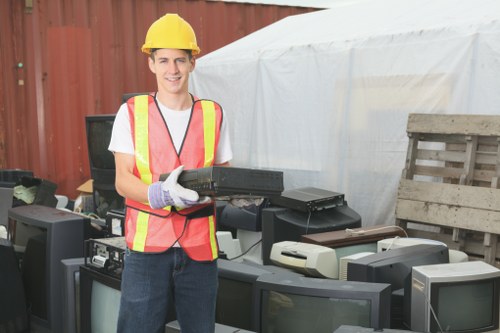 Risk assessment is central to safe rubbish clearance and should cover manual handling, slips and trips, sharp objects, asbestos or other hazardous materials, and traffic management for vehicles used in waste collection. Routine risk assessments must be reviewed whenever a novel task arises or a site condition changes. Where hazards are identified, controls should follow the hierarchy: eliminate, substitute, isolate, engineer, administrate and use PPE as the last resort.
To support safe operations, the company promotes a culture where staff feel able to stop unsafe work. Supervisors will maintain incident logs and conduct regular safety inspections. Incident investigations will identify root causes and corrective actions so that similar risks are mitigated in the future. All employees participating in office clearance and rubbish collection are encouraged to suggest practical improvements to operational safety.
Safe Systems, Training and PPE
Staff involved in office clearance and rubbish removal must be trained in manual handling techniques, safe use of trolleys and lifts, correct storage of waste bags and containers, and secure loading of vehicles. Regular refresher training reinforces good practices for teams working across the service area. Strong emphasis is placed on correct posture, team-lifting procedures and the safe use of mechanical aids to reduce musculoskeletal injuries.
 Any equipment provided for removal tasks must be maintained and inspected according to the manufacturer’s guidance. The company provides PPE as required and ensures that it is suitable for the hazards encountered during building clearance, such as gloves for sharp items, eye protection for dust-generating tasks, and hi-vis garments when working near vehicle movements. Employees must report damaged or worn equipment immediately.
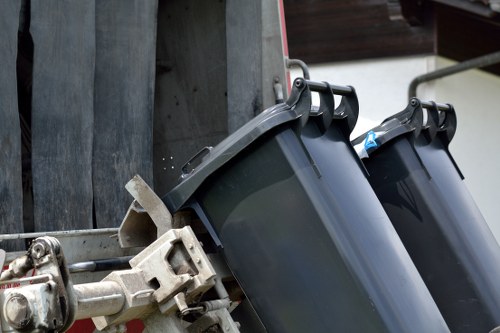 Waste classification and containment are important to reduce exposure and environmental risk. Teams should segregate recyclable items, general office rubbish and hazardous materials. Where chemical or biological contamination is suspected, clearance must cease until competent assessment and safe removal methods are agreed. Clear labelling and secure packaging for hazardous or confidential waste supports safe transport and disposal across the rubbish company service area.
Emergency Procedures and Health Considerations
Emergency arrangements should be established for all office clearance activities. These include first aid provision, evacuation procedures for sites where clearance is underway, and access to nearest medical assistance. Staff training should include guidance on dealing with cuts, crush injuries, and accidental exposure to hazardous substances. Managers will ensure that first aid kits are available and suitable for the types of work being undertaken.
Health surveillance may be necessary for specific risks, such as repeated manual handling or exposure to dust and fumes. The organisation will promote wellbeing and encourage reporting of any persistent symptoms that could be work-related. Preventive measures and early intervention help reduce long-term health impacts for clearance operatives.
To reinforce safe working, the policy is supported by a programme of site checks, regular toolbox talks and documented procedures. The company will review this policy periodically and after significant incidents to ensure it remains effective and applicable to the evolving nature of office clearance and rubbish removal work across the service area.
Monitoring, Review and Continuous Improvement
Performance indicators such as incident rates, near misses, training completion and equipment inspection records will be used to monitor safety performance. Management will conduct audits and use findings to drive improvements in clearance methods and rubbish company operations. Employees are expected to cooperate with reviews and to contribute to practical safety improvements.
Key controls and actions include:
- Pre-job planning and risk assessment for every clearance task.
- Appropriate PPE and equipment that is well maintained.
- Clear roles for supervisors and crew members to manage hazards.
By embedding these practices across the organisation, the company aims to deliver safe, reliable and responsible office clearance and rubbish removal services while protecting workers, clients and the wider environment.
